

GRACE · Platform & guided demo
One community.
Connected perspectives.
Support for member care, everyday administration and consistent follow-up, designed to work alongside existing organizational systems.
AI-generated illustration · the fictional Pastor James from the Faithful demo
More presence. Less administrative burden.
GRACE stands for Growth, Resource, Assistance, Community, Engagement. Five connected pathways for the life of your community.
The purpose of GRACE is practical: help your team keep people, care and follow-through in view, so administration takes less of the attention people need. Start with a task that matters to your organization and evaluate whether the platform helps.
Watch the full platform walkthrough ↗A practical way to evaluate it
- Watch. See the platform walkthrough.
- Explore. Try the staff and member demos with sample data.
- Evaluate. Inspect the calculator’s assumptions, then discuss a bounded pilot.
A demonstration is a starting point for evaluation. Live use depends on the readiness of the selected workflows.
Thoughtful adoption starts with your judgment.
Questions about AI belong in the conversation. You do not need to adopt every capability, replace your systems at once, or move faster than your organization is ready.

AI Navigator supports the work.
Within GRACE, Navigator helps staff explore authorized information and prepare next steps. It supports people who know their community; it does not provide spiritual authority or replace relationships within your community.
Your questions about AI and community ↗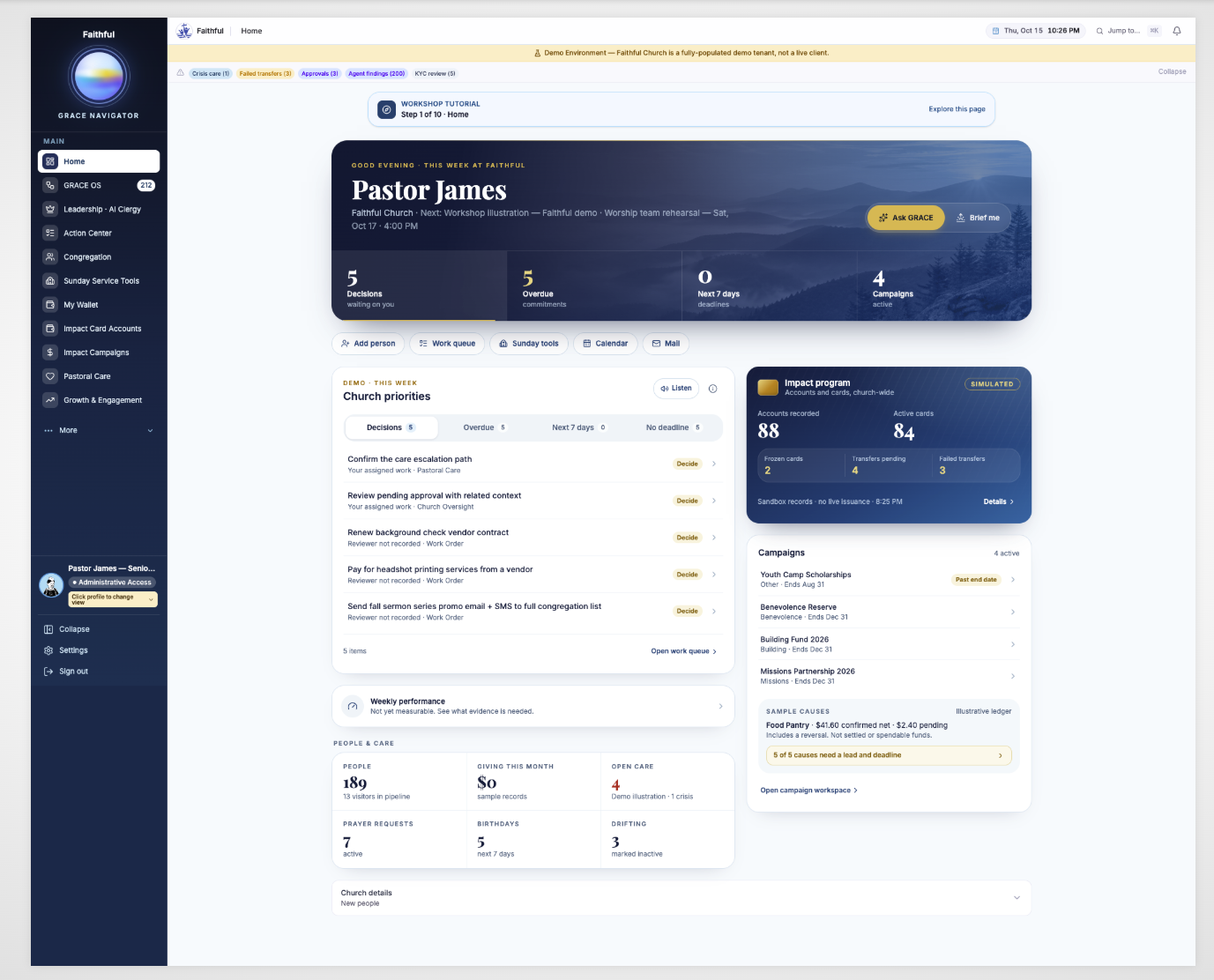
Actual Faithful demo. Sample people, activity and financial figures; no live card issuance. Select the image to enlarge.
Explore the Faithful workshop ↗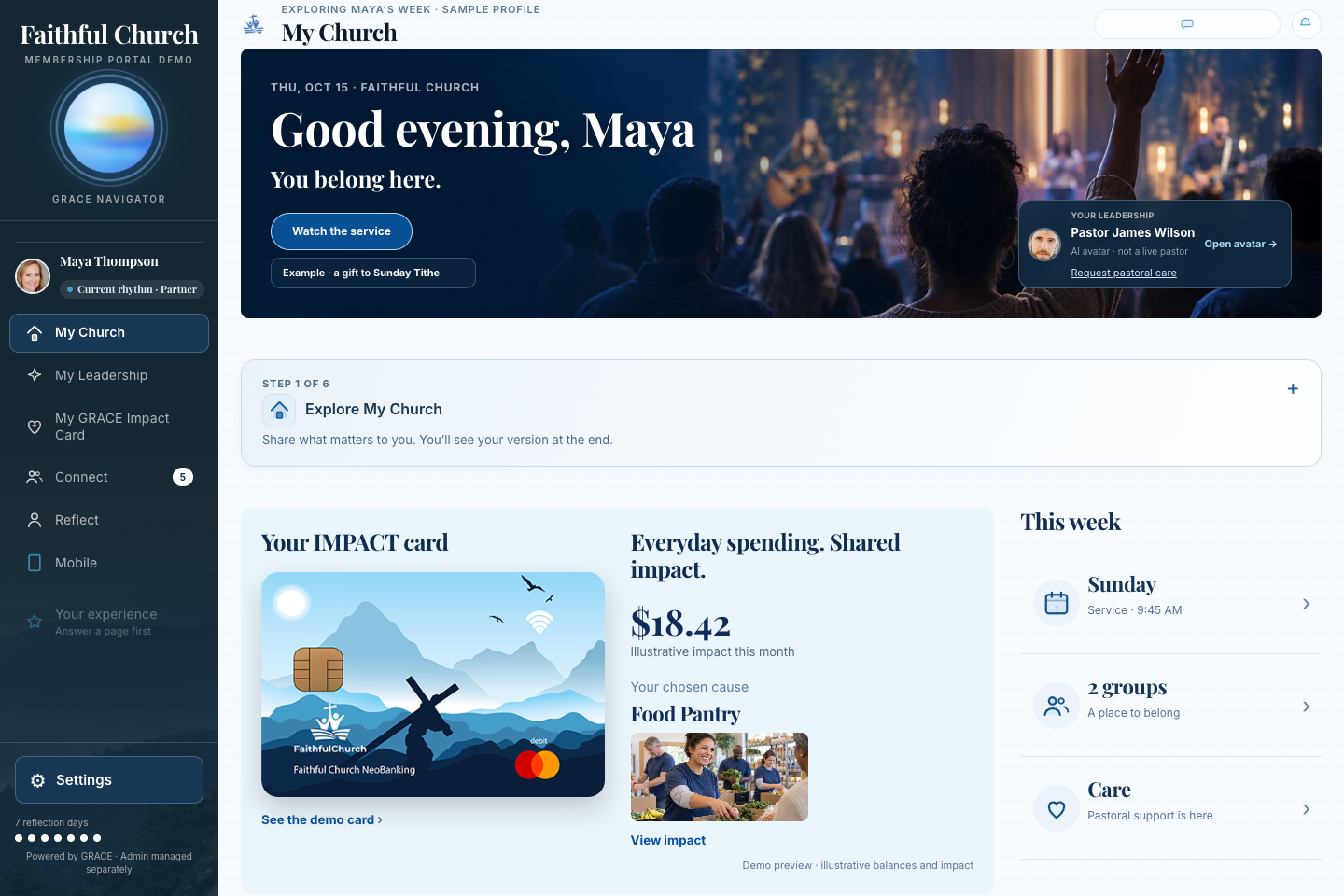
Actual member portal demo. Sample profile, illustrative impact and balances.
Explore the member experience ↗Your community, throughout your week.
Follow Maya’s sample week, explore the portal’s optional questions, and see the member experience from everyday reflection to groups and care.
The phone link opens Maya’s sample, not your workshop answers. People and money figures are illustrative; no real card is issued.
Looking ahead: a proposed organization-branded account would bring payments, a wallet and rewards into GRACE, subject to partner terms. Explore the financial vision ↗
What could GRACE mean for your organization?
Explore a planning scenario with visible assumptions. Estimates are not guaranteed savings. Future card potential is separate from operating value.
Different ways into the same work.
CRM workspace: the staff view
The current workspace brings together people, care, Sunday preparation, communications and operational follow-through. The public demo uses Faithful, a fictional church. A live pilot needs its own agreed scope and readiness review.
Ask GRACE: assistance within your role
Staff can ask about the records their role permits and prepare changes for an explicit action. Members use a separate assistant scoped to their own record. Connecting Ask GRACE proposals to the wider decision queue remains in development.
Virtual Campus: a spatial view, partially built
The campus offers another way to navigate the church’s operating environment and view agent status. It is not a separate system of record or a live facilities-management product.
People remain responsible for consequential decisions
GRACE’s direction centers on permissions, named decisions and records of activity. Consequential proposals require accountable review; some deliberately enabled routine communications and staff-task workflows can run automatically. Specialized helpers are partially built and currently read-only. A self-improving playbook system is a future direction.
Room for honest questions
You can be curious.
And careful.
Thoughtful evaluation leaves room to ask questions, set boundaries and decide what fits.
Will AI make our work feel less human?
It should not become a substitute for listening, presence or human judgment. Our aim is to support the administrative work around community life so people can focus on relationships. Your organization decides which tasks are appropriate for assistance and which should stay entirely with people.
How do we know its answers are reliable?
AI can make mistakes. Use the Faithful demo to compare responses with the underlying records and review proposed changes before acting. Start with bounded workflows, agree what a useful result looks like, and evaluate the evidence. A demonstration is not a guarantee of accuracy in every situation.
What about privacy and security?
Before a pilot, review the permissions, data boundaries, retention, integrations and security findings for the scope you intend to use. GRACE is designed around role-based access. Organization-level isolation and any data sharing must be confirmed for your proposed setup, with concrete evidence, before live information is introduced.
Does every automated action need approval?
Consequential decisions need accountable human review. Some deliberately configured routine communications and staff-task workflows may run automatically. Ask GRACE and other capabilities have different levels of readiness; review the exact behavior and controls of the workflows included in your pilot.
Do we have to adopt it now?
No. Watch the walkthrough, explore with sample data and take time to decide. If there is a useful fit, begin with a limited scope alongside your existing systems. Waiting, narrowing the scope or deciding it is not right for your organization are valid outcomes.
A meaningful next step